
When people book leaflet distribution, they usually ask two things: how much, and how many leaflets. After 23 years of doing this job in London and Essex, I can tell you those are not the questions that decide whether your leaflets actually reach the doors.
The question that matters is simple: how many people will walk your postcode, and for how long?
Why the number of people matters more than the number of leaflets
Every company can say "we'll deliver 20,000 leaflets". The leaflets don't walk by themselves. Someone has to carry them, street by street, door by door. A good distributor working properly covers roughly 1,000 to 1,200 houses in a shift in a normal suburban area. It can be less on hills, in rural roads or with heavy leaflets, and the number of letterboxes can be higher where houses are split into flats with their own doors.
So if 20,000 leaflets are going out in one day, you can work out yourself how many people that really needs. If the answer you get is "three or four", ask how. That's the honest maths of this job.
Our real numbers, told in advance
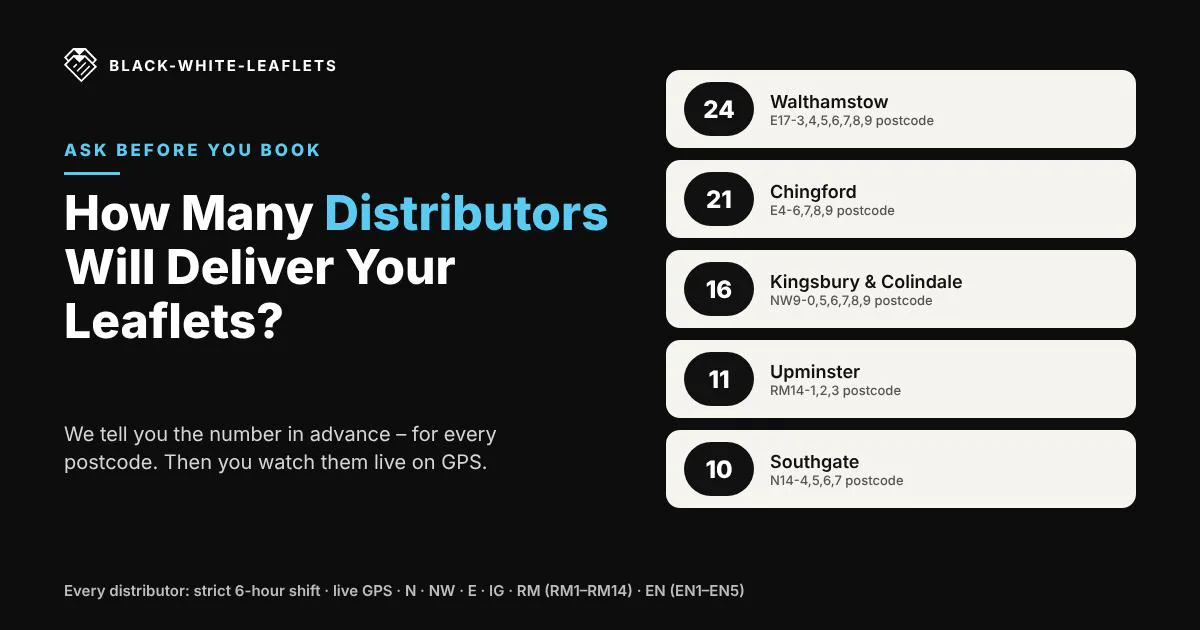
This is what we send, in real areas we work every month. Every distributor works a strict 6-hour shift and is tracked live on GPS:
| Area | Postcode | Distributors |
|---|---|---|
| Walthamstow | E17-3,4,5,6,7,8,9 postcode | 24 |
| Chingford | E4-6,7,8,9 postcode | 21 |
| Kingsbury & Colindale | NW9-0,5,6,7,8,9 postcode | 16 |
| Leytonstone | E11-1,2,3,4 postcode | 15 |
| Loughton | IG10-1,2,3,4 postcode | 13 |
| Upminster | RM14-1,2,3 postcode | 11 |
| Southgate | N14-4,5,6,7 postcode | 10 |
| Finsbury Park | N4-1,2,3,4 postcode | 10 |
| South Woodford | E18-1,2 postcode | 5 |
For any postcode in N, NW, E, IG, RM (RM1-RM14) and EN (EN1-EN5), we tell you the number before the job starts, not after.
Why the numbers are different from area to area
People sometimes ask why Loughton needs 13 people for around 13,000 letterboxes, while Finsbury Park needs 10 for 17,000. It's the streets. In Finsbury Park the houses are close together and many have several flats with their own letterboxes. In Loughton the roads are longer, the houses are bigger and further apart, and there are hills. A rural village like Abridge has about 2,000 houses, and still needs 3 people, because of the walking between them.
The weight of the leaflet matters too. A thin A5 is light. A thick A3 or a booklet is heavy, and the same area then needs more people, because nobody can carry 40 kilos and still walk properly for six hours.
Houses walked vs leaflets delivered: why the numbers aren't the same
This is the part people often misunderstand, so I want to explain it properly, because it's not a trick. It's how London streets are built.
A distributor in an urban area like Finsbury Park, Walthamstow or Leytonstone might walk past around 1,200 to 1,300 houses in a shift, and still post 1,800 to 2,000 leaflets. How?
- Houses split into flats. One Victorian house is often two or three flats (Flat A, Flat B, Flat C), each with its own door, its own bell and its own letterbox. That's one house, but three homes and three leaflets.
- Letterbox panels on the wall. Small buildings often have a row of letterboxes by the front door: four, six, eight boxes on one wall. Each box is a separate home.
- Ground-floor doors. Converted buildings with separate street-level doors: every door has its own letterbox.
So "1,200 houses" and "1,800 leaflets" can both be true on the same route. Every leaflet goes into a real letterbox of a real home: one leaflet per letterbox, never two in the same box.
That's also why Finsbury Park (N4-1,2,3,4 postcode) needs 10 distributors for around 17,000 letterboxes, about 1,700 each, while in Loughton (IG10-1,2,3,4 postcode), where it's mostly separate family houses, one house means one letterbox, and each distributor delivers around 1,000.
In suburban and rural areas it's the opposite: one house, one letterbox, and longer walks between them, so each person delivers fewer leaflets, and we send more people.
Households and letterboxes are not the same thing
Here is something many people don't know. The household numbers you see online (Royal Mail figures) include flats in secure blocks and housing estates. Our distributors don't carry fobs or keys, so we don't go into secure blocks, and we never deliver where there's a "No junk mail" sign. That means the real number of letterboxes we can reach is at least 5% lower than the household figure (more in areas with many flats and secure blocks).
We tell you that before you book, so you can print the right quantity. In Leytonstone (E11-1,2,3,4 postcode), for example, the household figure is just over 20,500, and we deliver around 19,000.
Why a strict 6-hour shift
Because after six hours of walking, people get tired, and tired people rush. We want every leaflet to go fully through the letterbox, gates closed behind us, no leaflets left on the floor. A strict shift with enough people is how you get that.
And I'll be honest: sometimes we get an area wrong. This month, on a new area in Essex, we planned 11 people and the area really needed 13. The team stayed two to three hours longer and finished the job properly. We paid them for every extra hour (the client didn't pay a penny more), and we changed our plan for that area. That's the rule: if we get it wrong, it's our cost, not yours.
GPS on its own is not enough
Most distribution companies now say they use GPS, and that's good. But GPS only shows you where someone walked. It doesn't tell you how many people were supposed to be there. Our way is both together: the number of people booked in advance, then GPS live, so you can check for yourself that the number we promised is the number that walked your streets. You get the tracker numbers on the morning of the job, and a full report with route maps within 2 hours of finishing.
What we guarantee, and what we don't
We guarantee: the number of distributors agreed in advance, a strict 6-hour shift, only the postcodes we agree, live GPS and a full report within 2 hours.
We don't guarantee: how many calls or sales you get. That depends on your offer, your design, your area and your timing. Nobody can honestly promise you a response, and if someone does, ask them to put it in writing.
Six questions to ask any leaflet distributor
- How many distributors will walk my postcode?
- How many hours is each shift?
- Exactly which postcodes will you cover (for example E17-3,4,5)?
- Is that number households or letterboxes you can really reach?
- Can I watch the distributors live on GPS on the day?
- When do I get the report and the route maps?
If you get clear answers to all six before you pay, you're in good hands, whoever you book with.
Leaflet distributors: FAQ
How many houses can one leaflet distributor deliver in a day?
In a normal suburban area, around 1,000 to 1,200 houses in a 6-hour shift. Fewer in rural areas, on hills or with heavy leaflets; more letterboxes where houses are split into flats.
Why can one distributor deliver more leaflets than houses on the route?
Because in urban areas one house is often split into two or three flats with their own letterboxes, and small buildings have letterbox panels on the wall. A distributor might walk 1,200 to 1,300 houses and post 1,800 to 2,000 leaflets, one per letterbox, never two in the same box.
Will you tell me how many distributors you'll send before I book?
Yes. For any postcode in N, NW, E, IG, RM (RM1-RM14) and EN (EN1-EN5) we give you the number of distributors in advance.
Do you deliver to blocks of flats?
Only where letterboxes are on the outside wall or at ground-floor doors. We don't enter secure blocks or housing estates, and we skip "No junk mail" signs.
Do you guarantee a response from my leaflets?
No. We guarantee the distribution: the people, the hours, the postcodes and the GPS proof. Response depends on your offer, design, area and timing.
Want to know how many distributors your postcode needs?
Send us your postcode on WhatsApp or call 07739 556 456, and we'll tell you the number, in advance. You can also get a quote or send us a message.