
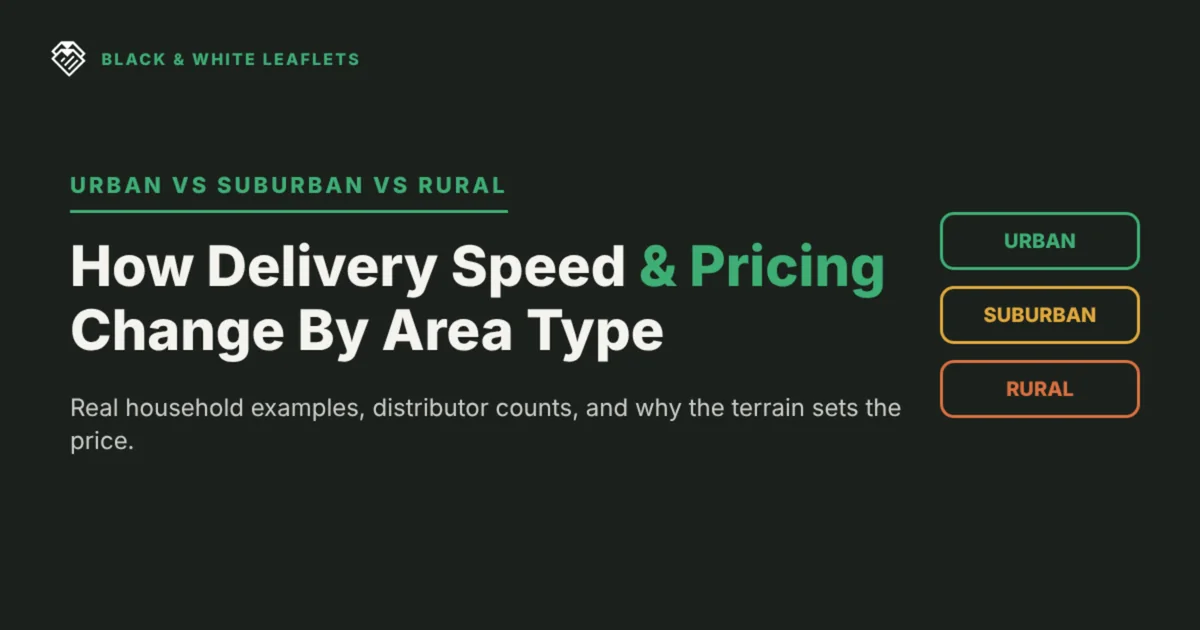
Not every postcode delivers at the same speed, and that isn't down to how hard a distributor works — it comes down to how far apart the front doors are. A tightly packed London street, a spread-out suburb and a rural village each need a completely different number of people on the ground to cover the same 10,000 households in a day. That difference is also exactly why our pricing changes by area type. Here's the real breakdown, with the household examples and numbers behind it.
Urban Areas
Tightly packed streets mean the fastest pace and the fewest distributors needed. Our distributors cover 150–180 leaflets an hour in Urban areas, rising to up to 210 an hour for an experienced team.
Example: Leyton, E10 — 10,000 leaflets, split roughly 2,000 per distributor across a team of 5, fully mapped for a 6-hour day.
One detail worth explaining, because the numbers can look odd at first glance: many Urban houses across London are split into flats with separate doorbells — A, B, sometimes C. That's extremely common on converted terraced streets. So a single house-stop can mean posting 2 leaflets instead of 1. We deliver to houses, not large blocks of flats — but on streets like this, the leaflet count naturally runs a little higher than the number of individual houses actually visited, which typically comes to around 1,200–1,470 houses per distributor across a 6–7 hour day. That's the real reason Urban leaflet counts can sit above a simple hours × rate calculation, and it's a direct result of London's housing stock, not an inconsistency in our numbers.
Suburban Areas
More ground between doors means a steadier pace and a bigger team to cover the same volume. Suburban areas run at 100–130 leaflets an hour, up to 160 an hour for an experienced distributor.
Example: Loughton, IG10 — 10,000 leaflets, split roughly 1,000 per distributor across a team of 10, fully mapped for a 6-hour day.
Suburban properties are almost always one letterbox per house — no flats to average across — so the number of leaflets delivered and the number of households actually reached match exactly.
Rural Areas
Spread-out households mean more walking between every single letterbox, and the largest team of the three. Rural areas run at 50–80 leaflets an hour, up to 100 an hour for an experienced distributor.
Example: Tunbridge Wells, TN1–TN2 — 10,000 leaflets, split roughly 670 per distributor across a team of 15, fully mapped for a 6-hour day.
Same as Suburban — one letterbox per property, so every leaflet delivered is exactly one household reached, no averaging needed.
Why The Price Follows The Terrain
Every distributor costs the same for a day's work, regardless of where they're working. What changes is how many households one distributor can realistically reach in that day — and that's what sets the price.
In our six core postcodes (E, EN, IG, N, NW and RM) — which covers Urban examples like Leyton and Suburban examples like Loughton — standard pricing applies: Shared Drop (1+2) at £50 per 1,000 + VAT (£60 in EN6–EN11), Shared Drop (1+1) at £65 per 1,000 + VAT, or a fully exclusive Solus Drop at £130 per 1,000 + VAT. Outside the core six, Shared Drop pricing starts from £60–£65 per 1,000 + VAT depending on area — get in touch for your exact postcode.
Rural and other low-density areas work differently. With households spread further apart, it simply takes more distributors to cover the same 10,000 leaflets in a day — and because there often isn't a second or third non-competing business in the same sparse area to share a round with, rural work usually runs as a single flat rate rather than a Shared Drop split. We size that rate to exactly how many distributors the real household count requires, in three bands:
- 8–10 distributors needed per 10,000 households: £130 per 1,000 + VAT
- 11–13 distributors needed per 10,000 households: £150 per 1,000 + VAT
- 14–16+ distributors needed per 10,000 households: £170 per 1,000 + VAT
Our Tunbridge Wells example above needs 15 distributors per 10,000 households, which places it in the top band at £170 per 1,000 + VAT. We always check the real household count for your specific postcode sector before quoting — never a guess.
What They're Actually Carrying
The fewer doors there are per street, the further each leaflet has to be carried before the next one goes through a letterbox. On a tightly packed Urban street, a distributor restocks constantly and carries a light load between doors. On a Rural round, with long gaps between properties, each distributor is carrying a heavier load over a much longer stretch before the next drop.
That's exactly why every distributor works from a proper trolley, not just a shoulder bag — sized to the round, not just the postcode. On a Rural day, the trolley is doing as much of the work as the arm.
The Numbers
- Urban: 150–210 leaflets/hour per distributor, roughly 5 distributors per 10,000 households, standard core-postcode pricing
- Suburban: 100–160 leaflets/hour per distributor, roughly 10 distributors per 10,000 households, standard core-postcode pricing
- Rural: 50–100 leaflets/hour per distributor, 15+ distributors per 10,000 households, flat rate £130–£170 per 1,000 + VAT depending on density
- 97.9% verified delivery rate across every completed route, in any terrain
- GPS tracking and a full delivery report within 2 hours of completion, on every round
Urban, Suburban and Rural Leaflet Distribution: FAQ
Why does the price change between Urban, Suburban and Rural?
Every distributor costs the same for a day's work, but how many households they can reach in that day drops sharply as properties spread out. Rural rounds need two to three times as many distributors to cover the same leaflet count as an Urban round, so the price per 1,000 rises to reflect that.
Why does the Urban leaflet count sometimes look higher than the hourly rate suggests?
Because many Urban houses across London are converted into flats with separate doorbells (A, B, sometimes C). One house-stop there can mean 2 leaflets rather than 1, so total leaflets delivered can run a little ahead of the number of individual houses visited. Suburban and Rural properties are almost always single-letterbox, so there's no gap there.
How do you decide the price for a Rural or low-density area?
We work out how many distributors a 10,000-leaflet round genuinely needs for the real household density in that postcode sector, then place it in one of three bands — £130, £150 or £170 per 1,000 + VAT — rather than guessing or quoting a flat rate regardless of area.
Do you deliver to blocks of flats?
No — our distributions go to individual houses. Where a house has been converted into flats with separate letterboxes, we deliver to each one, but we don't run rounds through large apartment blocks.
Get a Tailored Quote for Your Area
Whatever the terrain — tightly packed streets, suburban roads or a spread-out rural postcode — we size the team and the price to match the real household density, backed by GPS tracking on every single round. Call 07739 556 456 or get in touch online for a tailored quote for your area.